Pool pH Too High: How to Lower It Safely (Step-by-Step)
High pH is the most common chemistry complaint from pool owners — cloudy water, weak chlorine, scale on tile. The fix is simple once you know the dose and the order of operations. Here's the playbook.
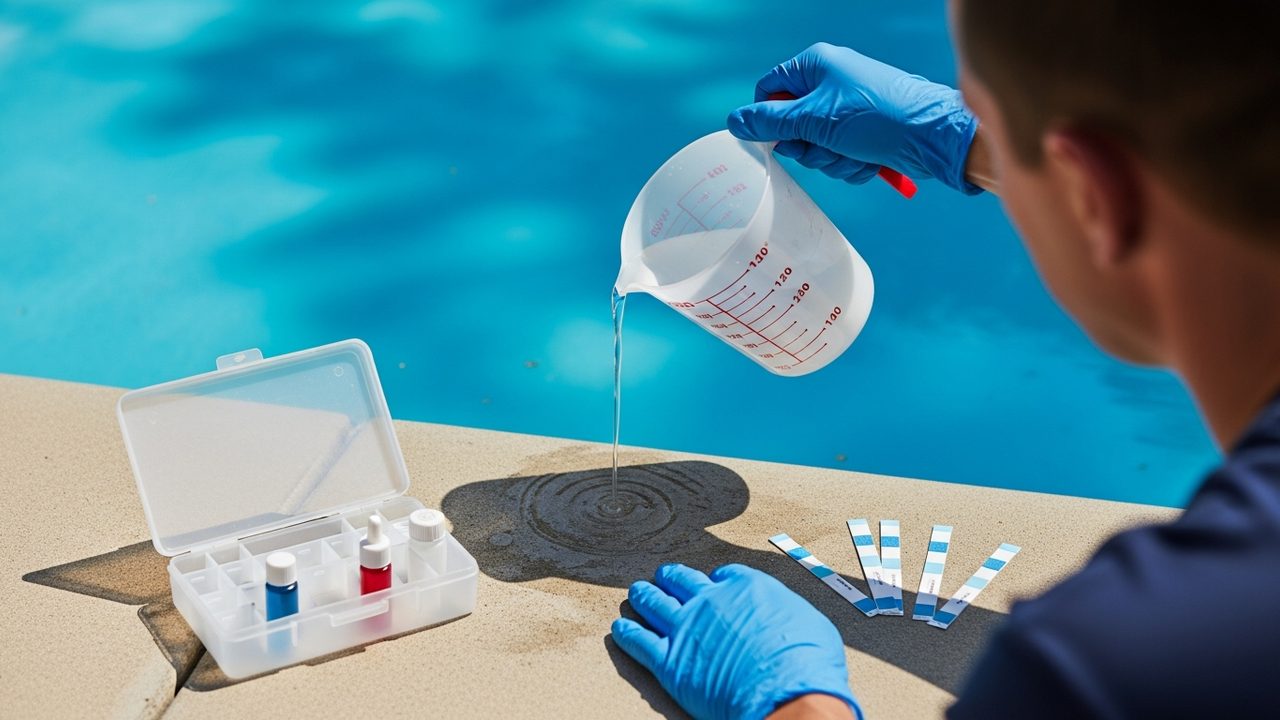
TL;DR — the fast fix
For a 20,000-gallon pool with pH 8.0 and total alkalinity (TA) around 100 ppm, add about 25 fl oz of muriatic acid (31.45%) to bring pH down to ~7.5. Pour slowly into the deep end with the pump running. Retest in 30 minutes. If pH keeps climbing back up, the real fix is lowering your TA — keep reading.
What "too high" actually means
Pool water runs best at pH 7.4–7.6. Above 7.8 you start losing chlorine efficiency and risking scale; above 8.0 the water goes cloudy and swimmers complain about eye and skin irritation. Counter-intuitively, high pH causes more burning eyes than low — because it depresses chlorine's sanitizing power and lets chloramines build up.
| pH | What's happening | Action |
|---|---|---|
| 7.8–7.9 | Mild. Chlorine is ~50% as effective as at 7.4. No visible issue yet. | Small acid dose, recheck next day |
| 8.0–8.2 | Cloudy potential; scale risk on heater; chlorine weak. | Correct now, then address cause |
| 8.3+ | Expect cloudy water, heater damage, stinging eyes. | Correct immediately; test TA and CH |
Why pool pH rises in the first place
pH drift upward is the default state of most outdoor pools. The usual culprits, in order of how often they're the real cause:
- High total alkalinity (TA). Alkalinity is a buffer that resists pH change — but when it's high (say, 140+ ppm), it actively drags pH up. You'll add acid, watch pH fall, then watch it rise right back within days. Lowering TA is the permanent fix.
- Salt water generators (SWGs). The electrolysis process is mildly basic; salt pools almost universally trend pH high.
- Aeration. Waterfalls, spa jets, aerators, and even a heavily-splashed pool outgas CO₂, which raises pH. Paradoxically this is also the trick we use on purpose later.
- New or resurfaced plaster. Fresh plaster leaches calcium hydroxide for up to a year, pushing pH up steadily.
- Liquid chlorine dosing. Sodium hypochlorite is basic. Big doses bump pH temporarily.
- Source water. In many municipalities the tap water comes out at pH 8+ by design — to protect pipes.
Test accurately before you dose
Test strips are fine for a quick check but don't trust them for dosing decisions. They drift out of range fast and tend to over-read pH. Use a liquid reagent test (Taylor, LaMotte, or the Taylor K-2006 for everything) — a phenol red drop test is accurate to 0.2 pH and takes ten seconds.
Test pH and TA at the same time. You can't plan the right treatment without both.
Lowering pH with muriatic acid
Muriatic acid (hydrochloric acid, typically sold at 31.45% strength, sometimes 14.5% "low-fume") is the standard tool. It's cheap, works fast, and adds nothing to the water that persists — just chloride, which every pool has plenty of.
Dosing chart — muriatic acid (31.45%)
These are approximate doses to lower pH from 8.0 to 7.5 at various alkalinity levels. Higher TA resists change, so you need more acid.
| Pool size | TA 80 ppm | TA 100 ppm | TA 120 ppm | TA 150 ppm |
|---|---|---|---|---|
| 10,000 gal | 10 fl oz | 12 fl oz | 14 fl oz | 18 fl oz |
| 15,000 gal | 15 fl oz | 18 fl oz | 21 fl oz | 27 fl oz |
| 20,000 gal | 20 fl oz | 24 fl oz | 28 fl oz | 36 fl oz |
| 25,000 gal | 25 fl oz | 30 fl oz | 35 fl oz | 45 fl oz |
| 30,000 gal | 30 fl oz | 36 fl oz | 42 fl oz | 54 fl oz |
Dry acid (sodium bisulfate) — the alternative
Dry acid is easier to handle and store, and it's what pool stores will push on you. It works — but every pound you add also adds sulfates, which build up permanently and, above ~300 ppm, damage plaster, stone coping, and salt cells. Use dry acid occasionally; for frequent pH drops (SWG pools, high-TA pools), stick with muriatic.
Step-by-step procedure
- Test pH and TA with liquid reagents.
- Calculate the dose from the chart above (or use PoolTrack's pool health check, which flags high pH and TA together).
- Turn the pump on and leave it running for the full procedure plus at least 30 minutes after.
- Measure the acid in a dedicated plastic cup. Don't eyeball it from the jug.
- Pour slowly into the deep end, low to the water, into a return-jet current. Walk the long way around and pour steadily — don't dump.
- Wait 30 minutes, retest, and repeat with a smaller top-up dose if needed.
- Do not swim for at least 30 minutes after, and only once pH has settled in range.
- Always wear goggles and chemical-resistant gloves.
- Pour in open air with the wind at your back. The fumes are the dangerous part.
- Never add water to acid — always acid to water. Same rule at the pool: the pool is "the water," and you add acid to it.
- Never mix acid with chlorine, cal-hypo, or any other pool chemical in a bucket or near the point of addition. Wait 30 minutes between acid and chlorine doses.
- Store upright, away from metal tools and other pool chemicals. Fumes will rust anything within a few feet.
If pH keeps climbing back up
If you're dosing acid every few days and pH is right back at 8.0, your total alkalinity is too high. You need to lower TA — not keep fighting the symptom.
The aeration trick
This is the one counter-intuitive technique every pool owner should know. Here's the chemistry:
- Adding acid lowers both pH and TA.
- Aeration (splashing, jets aimed up, spa blower) raises pH only — it doesn't change TA.
- So if you add acid, then aerate, you drive TA down while pH bounces back up on its own.
How to do it
- Target TA around 70 ppm if you have an SWG, or 80–90 ppm for a traditional chlorine pool.
- Add enough acid to push pH down to ~7.0 (lower end of safe). Use the dosing chart as a starting point — for a big drop you'll want roughly 2–3× the 8.0→7.5 amount.
- Aerate hard: return jets pointed up at the surface, spa overflow running, kids cannonballing — whatever you've got. Run the pump continuously.
- Over 1–3 days, pH will climb back to 7.6+ on its own, with TA permanently lower.
- Repeat until TA is in your target range.
Special case: salt water pools
SWGs push pH up constantly — it's a fundamental property of the electrolysis reaction. Two things help:
- Run TA lower. 60–80 ppm is the sweet spot for salt pools. At 100+ pH will climb alarmingly fast.
- Don't over-chlorinate. If your cell runtime is higher than it needs to be, you're generating unnecessary pH rise. Match cell output to actual chlorine demand.
FAQ
How long after adding acid can I swim?
Wait at least 30 minutes with the pump running, and only swim once pH and chlorine both test in range. For a large correction, give it an hour.
Can I use vinegar?
Technically yes — vinegar is a weak acid — but you'd need gallons to do what a cup of muriatic does. It also adds acetate, which chlorine has to burn off. Don't bother.
My pH is high but TA is low. Now what?
Unusual but possible after heavy rainfall or a big cal-hypo shock. Just add acid using the TA 80 column of the chart — you'll need less than you think. Then bring TA up gently with baking soda.
Can a pool test strip tell me TA accurately?
Not reliably above 100 ppm — strips saturate. A drop-count TA test takes a minute and is accurate to 10 ppm. Worth owning.
Does shade help?
It reduces evaporation (and therefore concentration), which slows pH creep slightly. Not a fix — but if you have a choice, a partially shaded pool is a lower-maintenance pool.
Let PoolTrack do the math
Calculating acid doses by hand is tedious and easy to get wrong. PoolTrack logs every reading and adjustment, predicts when your pH will drift out of range, and tells you exactly how much acid to add for your pool, your TA, and your CYA.
Keep reading
- TreatmentHow to Shock a Pool (and How Much Shock You Actually Need)Skip the mystery bag of shock. Use your CYA to set the real target, dose liquid chlorine, and retest until free chlorine holds overnight.
- TroubleshootingCloudy Pool Water: Causes and How to Clear ItCloudy water is a diagnosis, not a product. Work through filtration, free chlorine, and pH before you dump another bottle of clarifier.
- DosingHow Much Liquid Chlorine to Add to Your Pool (With Dosing Charts)A plain-English dosing guide with tables for 10k, 15k, 20k and 30k gallon pools — plus when to add, how to shock, and how to avoid wasting chemicals.
- ComparisonPoolTrack vs Pool Math: An Honest ComparisonPool Math is the default for TFP users. Here's where it still wins, where it feels dated, and why thousands of pool owners are moving to PoolTrack.